Preparation for the Professional Photographer in Edinburgh, Scotland - Top 10 Tips
Hi Everyone
As a professional corporate and event photographer working in Edinburgh and throughout Scotland, you cannot underestimate the need to properly prepare for corporate and event photoshoots. lets take the example of a conference photographer working at an event in Scotland for instance. You will have been given a brief in advance by the client with instructions as to what they want from you as a photographer. it is then your duty to do just that and also go beyond what they requested. Here is list of things you need to do to prepare for a photoshoot:
1. Make sure you understand the brief, including the location, timings, when they require the photos, key people etc and if something is not clear, then ask in advance of the meeting.
2. Sometimes its the unexpected things that cause problems, be sure you can get to the location with lots of time to left, so that you a have al least an hour and a half to spare to allow for any disasters such as traffic, car problems etc. A delegate can be late for a conference but the photographer can't.
3. Get all your gear ready a couple of days before, so you have time to buy batteries etc if there are any problems. This includes charging lots of batteries, cleaning the equipment, making sure it works etc.
4. Think clearly about what photos you will be taking and select the gear you need, ie will you need a macro lens or a telephoto, will it be better to use smaller mirrorless gear etc. Don't over pack your bag, as you will have to lug the gear around and leave a lot of it unattended. However make sure you have back up in case of malfunction.
5. Map out the timings and write them down, on a programme if possible. This is vital for conferences, weddings and PR, where timing is key.
6. Make sure you have the a note of the key contact people, name, email address and mobile number (for emergencies) ie the person who commissioned you and and main players at the event and introduce yourself in advance of the event if possible, or on the day.
7. Determine in advance when and how they want the photos ie if they require some on the day of the event then take a laptop etc, also establish in advance how and when you will be paid.
8. When you are arrive look professional and be friendly to everyone before the start of the event.
9. If you have a long day ahead and lets face it most conferences are, try and make sure you have as much energy as possible for the next day, get a good nights sleep the night before and try and relax.
10. Finally, enjoy and get creative.
Hope this help.
Until next time.
Kind Regards
Colin
www.colinwrightphotography.co.uk
www.edinburghphotographer.com
the Kelpies in Infrared by professional fine art photographer Scotland Colin Wright
Hi All
A quick blog post. continuing in my quest to boost my infrared photography collection, to enable me to publish my Infrared Photography in Scotland book in the near future, I paid a second visit this year to the Kelpies in Falkirk. The weather was ideal for infrared photography with some blue sky and cloud and plenty of sunshine, there was even some dark skies and a storm about to start. I lost my polarising filter, which dropped into the lake, but it was worth it. Why is the Kelpies one of my favourite locations, well the metall surface of the installation is ideal for infrared light reflection for a start. Often as a professional event and corporate photographer working in Edinburgh and around Scotland, I am looking to include infrared images with the commission and this location is ideal. A storm was also brewing which created dramatic skies and the location also has a river, creating dark reflections on water, which is ideal, in addition there are boats and trees, all of which makes it a fascinating place to visit. So drop on over to the website and let me know what you think of the photos.
All the best.
Kind Regards
Colin
www.colinwrightphotogrpahy.co.uk
www.edinburghphotographer.com
Infrared Photos for Architecture and Corporate Photography in Scotland
Hi Everyone
As someone who is both a fine art photographer and also a professional corporate and event photographer in Scotland, I have often been asked how infrared photography can be utilised from a commercial point of view in everyday use. Whilst I am able to promote and sell infrared images from a fine art point of view, I can also present the images to my corporate and event photography clients, in addition to the photographs they have asked for and they are always happy with the results, often using the infrared photos in their final publications. This is the case for weddings. sport and PR photography, but it really comes into its own for architecture, urban photos, motor vehicles, vintage cars and landscape photography. You do require a commission which enables you to go outdoors and the weather has to be suitable ie some sunshine if possible and it is better with some blue sky and clouds. Architecture particularly lends itself to infrared, as the high dynamic range is ideal for this genre. Metallic objects show up really well in infrared. As an infrared photographer, I have different uses for my infrared converted camera, often I want to create a realistic photograph which has something just that little bit unique but can also represent a normal analogue photo, most of the time, especially in black and white, the client will not be aware it is in black and white, or they don't care, if they like the image, that is the main thing. A recent visit to the Falkirk Wheel was a case in point. This fantastic example of architecture and engineering, with the backdrop of a famous canal, overlooking countryside and hills is ideal for all types of infrared and it enables you to create something different at a location which has been photographed to death. The same is true for urban architecture and famous tourist scenes. Infrared can give you that something just a bit special to show the client. So keep this in mind. Always try and assert your own Unique Selling Point (USP) in your commissions, otherwise, the only real difference you have to the hundreds, no really thousands of other photographers out there, is your price.
Hope that helps.
Until next time.
www.colinwrightphotography.co.uk
www.edinburghphotographer.com
The Falkirk Wheel in In Infrared Photography
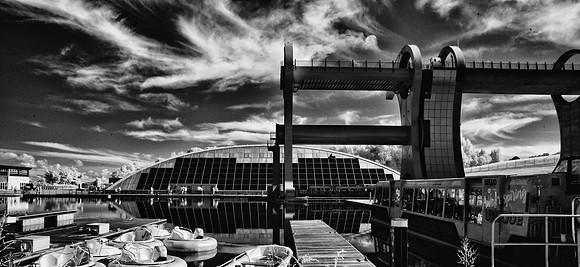

Falkirk Wheel by professional corporate and event and fine art photographer Colin Wright
The Wave Photography Project, Tips and Hints for Photographing Waves
Hi Everyone
As you know during lockdown, I was looking for projects in the absence of professional corporate and event photography commissions around Edinburgh and Scotland and one of the things I did was photograph waves during storms in Dunbar., in East Lothian. The other day, I extended the wave photography project to include infrared photography and a photo is attached. I thought this would be a good time to offer some tips on photographing waves and here are a few below:
1. Try not to use your best camera if possible. I once lost ad fairly new camera and lens to waves, soaking me and ruining the camera in the process.
2. Keep safe. the force of a wave can knock you flying and even draw you back to the water.
3. Experiment with shutter speeds, fast at about 1/800th and slow, with a monopod or tripod at 1/15th for example, for different effects.
4. Try close up to the waves and take in the context of the landscape also, ie with buildings or people in the background.
5. Think colour and black and white.
6. Experiment, I recently used my infrared equipment to arrive at different effects.
7. Try some low level shots parallel with the waves and some shooting from above.
8. Watch what everyone else is doing, then do something different.
9. Use telephoto and wide angeled lenses.
10. Last of all enjoy, but keep an eye on the wave, with the other on your camera. They have a habit of surprising you and soaking both yourself and worse of all, your camera.
That's all. Hope it helps.
Kind Regards
Colin
www.colinwrightphotogrpahy.co.uk
www.edinburghphotogrpaher.com